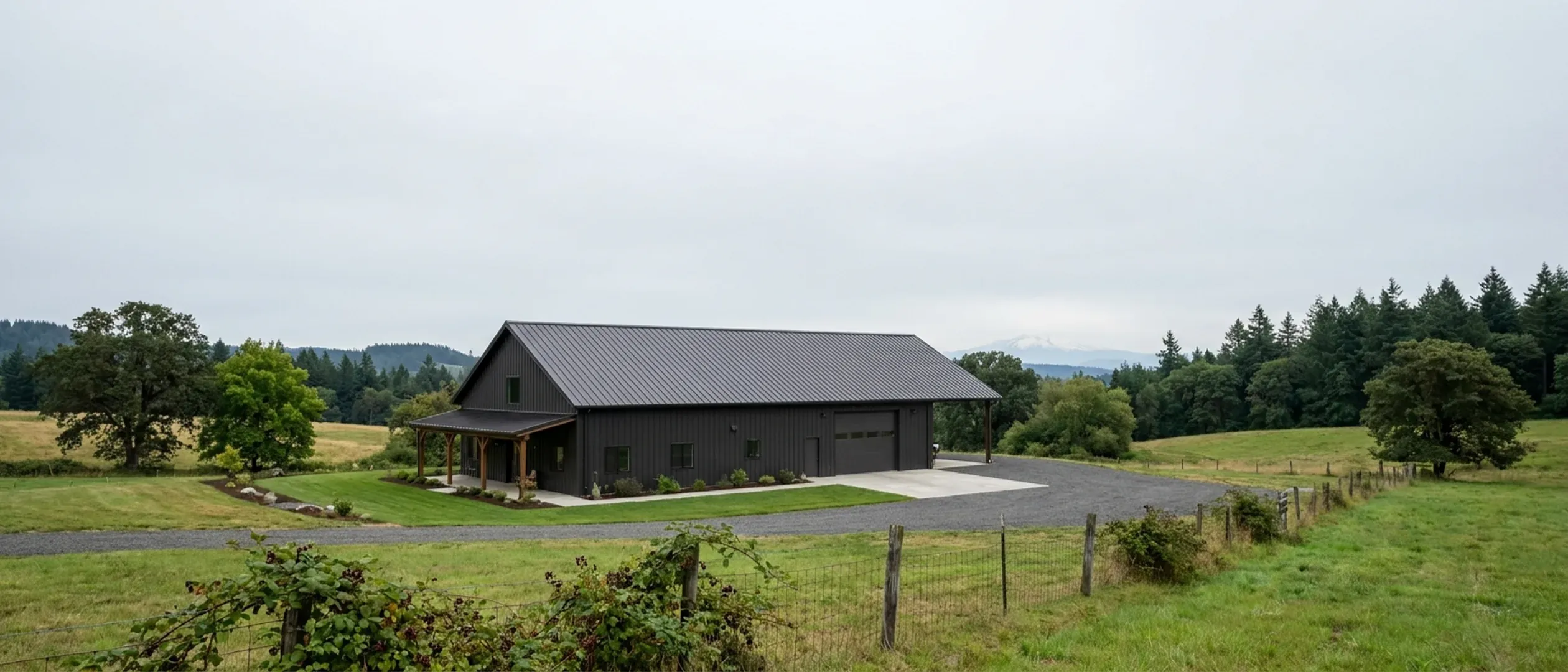
How Much Does It Cost to Build a Barndominium in Oregon?
Nobody publishes a measured cost for building a barndominium in Oregon, and a page that hands you one statewide price per square foot is guessing. What does exist is better than a guess. The Census Bureau measures what owners pay a general contractor to build a house on land they already own, and it reports the West region, which includes Oregon, on its own. The Census permit survey shows what Oregon's new single-family homes were valued at when permitted in 2025. USDA publishes what an acre of Oregon cropland and pasture is worth, and a study written for Oregon Housing and Community Services measured what cities charge in system development charges. This guide sets those figures side by side, each with its source, and shows where Oregon's own rules on farm land, septic and water add lines that a national average leaves out. None of it is our pricing, and none of it is a quote.
Figures below are industry data from cited third-party sources, not a quote from Oregon Barndominium Builders. Every project is priced individually.
Bottom Line Up Front
- The closest published benchmark is the Census Bureau's 2025 figure for contractor-built houses on the owner's own land in the West region: a median contract price of $176.87 per square foot and an average of $213.85, with the land excluded.
- Inside a city, system development charges are their own line. The 2022 Oregon study for Oregon Housing and Community Services put the statewide average for a single-family home at roughly $15,000, from under $5,000 in some small cities to close to $50,000 in parts of the Portland metro.
- On farm land the land-use answer comes before the price. Oregon law will not give final approval to a non-farm dwelling on farm-assessed land in an exclusive farm use zone until the parcel is taken out of farm assessment and any additional tax is paid, and outside an urban growth boundary that tax can reach back up to ten years.
Published cost figures
Third-party and government figures, each with its source. None of them is a quote, and none of them is ours.
| Measure | Range | Source |
|---|---|---|
| Contractor-built houses on the owner's land, West region, started in 2025: median to average contract price (land excluded) | $177–$214 per sq ft | U.S. Census Bureau, Characteristics of New Housing 2025, Median and Average Contract Price per Square Foot of New Contractor-Built Single-Family Houses Started: West median $176.87, average $213.85 (read 26 Sep 2026) — https://www.census.gov/construction/chars/xls/contractpricesqft_cust.xls |
| Detached new houses sold by builders, West region, 2025: median to average sales price (lot excluded) | $212–$222 per sq ft | U.S. Census Bureau, Characteristics of New Housing 2025, Median and Average Price per Square Foot of Floor Area in Detached New Single-Family Houses Sold: West median $211.98, average $222.47 (read 26 Sep 2026) — https://www.census.gov/construction/chars/xls/soldpricesqft_cust.xls |
| Average construction cost alone (no lot, overhead, marketing or profit), national builder survey, 2024 | $162 per sq ft | NAHB, Cost of Constructing a Home 2024 (January 2025): average construction cost $428,215, about $162 per square foot; national averages only (read 26 Sep 2026) — https://www.nahb.org/-/media/NAHB/news-and-economics/docs/housing-economics-plus/special-studies/2025/special-study-cost-of-constructing-a-home-2024-january-2025.pdf |
| Average permit valuation per new single-family home authorized in Oregon, 2025 (structure only, as declared on the permit) | $345,500 per home | U.S. Census Bureau, Building Permits Survey, annual 2025 state data: Oregon 1-unit valuation $3,183,398 thousand across 9,215 units, about $345,500 each (arithmetic; read 26 Sep 2026) — https://www.census.gov/construction/bps/xls/stateannual_202599.xls |
| Total city system development charges for a single-family home in Oregon, 2022: from under $5,000 in some small cities to close to $50,000 in parts of the Portland metro (statewide average roughly $15,000) | $5,000–$50,000 per home | Oregon System Development Charges Study, Final Report (ECONorthwest with FCS GROUP, for Oregon Housing and Community Services, 14 Dec 2022), based on 2022 data collected by FCS GROUP (read 26 Sep 2026) — https://www.oregon.gov/ohcs/development/Documents/Oregon%20SDC%20Study_FinalReport_121422.pdf |
| Oregon agricultural land, 2026 state average: pasture to irrigated cropland | $1,120–$8,200 per acre | USDA NASS, Land Values 2026 Summary (released 31 July 2026): Oregon pasture $1,120, non-irrigated cropland $3,050, irrigated cropland $8,200 per acre (read 26 Sep 2026) — https://www.nass.usda.gov/Publications/Todays_Reports/reports/land0726.pdf |
Total cost by size
Rough totals at common sizes. These move with everything on this page, so treat them as a starting orientation, not an estimate for your project.
1,500 sq ft
$265,000–$321,000
Arithmetic, rounded to the nearest $1,000: 1,500 sq ft × the Census 2025 West contract price per sq ft for contractor-built houses ($176.87 median, $213.85 average), land excluded — https://www.census.gov/construction/chars/xls/contractpricesqft_cust.xls
2,000 sq ft
$354,000–$428,000
Arithmetic, rounded to the nearest $1,000: 2,000 sq ft × the Census 2025 West contract price per sq ft for contractor-built houses ($176.87 median, $213.85 average), land excluded — https://www.census.gov/construction/chars/xls/contractpricesqft_cust.xls
2,500 sq ft
$442,000–$535,000
Arithmetic, rounded to the nearest $1,000: 2,500 sq ft × the Census 2025 West contract price per sq ft for contractor-built houses ($176.87 median, $213.85 average), land excluded — https://www.census.gov/construction/chars/xls/contractpricesqft_cust.xls
3,000 sq ft
$531,000–$642,000
Arithmetic, rounded to the nearest $1,000: 3,000 sq ft × the Census 2025 West contract price per sq ft for contractor-built houses ($176.87 median, $213.85 average), land excluded — https://www.census.gov/construction/chars/xls/contractpricesqft_cust.xls
What actually moves the number
The finish schedule, not the frame
In NAHB's 2024 national survey of builders, framing including trusses and sheathing is 16.6% of construction cost, while interior finishes are 24.1% and the plumbing, electrical and HVAC rough-ins are 19.2%. A barndominium's steel or pole barn shell changes the first of those lines. Cabinets, flooring, fixtures, drywall and the mechanical systems cost what they cost in any house, so two barndominiums with the same shell can land far apart once the inside is chosen.
Where the land sits: inside a city, or out on farm or forest ground
Oregon draws a line around every city, the urban growth boundary, and treats land differently on each side. Inside it you usually buy a smaller lot that already has water and sewer, and you pay the city's system development charges. Outside it, county zoning, whether farm, forest or rural residential, decides whether a house is allowed at all, and on farm and forest land that is a land-use decision under ORS chapter 215 that comes before any building permit. The cheapest acre is often the one where a new house is hardest to approve, so price the approval path with the land.
Septic and well on rural land
Off the city sewer, the Oregon Department of Environmental Quality, or the county acting as its contract agent, evaluates whether the site can take a septic system before a system is permitted, and a fee is charged per lot for that site evaluation under ORS 454.755. Contract counties set their own fee schedules under ORS 454.725, based on their costs. The result of the site evaluation decides what kind of system you can install, and the system type moves the price more than the fee does. A household well needs no state water right for domestic use up to 15,000 gallons a day under ORS 537.545, but it must be built by a licensed well constructor and recorded with the Water Resources Department, and the drilling, the pump and the pressure system are still yours to pay.
Fees the city charges before you connect
A system development charge is a fee a city or district collects at the building permit or at connection to pay for water, wastewater, drainage, transportation and parks capacity; those are the five kinds of capital improvement ORS 223.299 names. The 2022 Oregon study for Oregon Housing and Community Services found totals for a single-family home from under $5,000 in some small cities to close to $50,000 in some Portland metro jurisdictions, with a statewide average of roughly $15,000, and it noted that some of the smallest cities, particularly in eastern Oregon, charge none. Ask the city for its current schedule before you buy the lot.
Barndominium cost per square foot in Oregon: the published benchmarks
There is no Census table for barndominiums, so the useful question is which published house figure matches the way a barndominium is usually bought.
Contractor-built on your own land
The Census Bureau's contractor-built series covers houses built by a general contractor on land the owner already has, which is how most barndominiums are built. For houses started in the West region in 2025 it reports a median contract price of $176.87 per square foot and an average of $213.85, with the value of the lot excluded. The Census median contract price in the West was $377,200 and the average $535,700.
Built for sale, lot excluded
For detached new houses sold by builders in the West in 2025, the Census reports a median of $211.98 per square foot of floor area and an average of $222.47, again excluding the lot. Those prices include the builder's overhead and profit on a spec home, so they sit above the contractor-built figures.
What Oregon permits say
The Census permit survey counted 9,215 new single-family homes authorized in Oregon in 2025, with a combined permit valuation of $3,183,398 thousand, which works out to about $345,500 each. A permit valuation is the construction value declared on the application, so it leaves out the land and is not a finished price.
It is a house benchmark, not a barndominium price
The West region covers far more than Oregon, and the Census framing data show that in 2025 almost all contractor-built houses in the West were wood-framed. Use these figures to judge whether a quote is in the normal range for a finished house of that size. A barndominium quote that is far below them usually leaves out the interior, the site work or both.
Kit cost vs turnkey cost
The word 'price' means very different things at the kit stage and at move-in.
A kit prices the shell
A steel or pole barn kit usually covers the frame, roof and wall panels, and sometimes doors and windows. In NAHB's 2024 survey, framing is 16.6% of construction cost and exterior finishes are 13.4%, so even a complete shell is well under half of a finished house.
The foundation comes first
NAHB puts excavation, foundation, concrete, retaining walls and backfill at 10.0% of construction cost, and total site work, including permit, impact and water and sewer fees, at 7.6%. On a rural Oregon parcel the driveway, the pad and the trenching to utilities can be larger than on a city lot.
The inside is the largest share
Interior finishes are 24.1% of NAHB's construction cost and the mechanical rough-ins 19.2%. Insulating a steel or pole barn shell to meet the residential code is part of that inside cost, not an extra on the kit.
Turnkey adds the rest
A turnkey price bundles the shell, the site, the systems and the finishes into one number, which is closer to what the Census contractor-built figures measure. Compare a turnkey quote against those, and compare a kit quote only against other kits.
Land: what USDA says an Oregon acre is worth
USDA's 2026 Oregon averages
USDA's Land Values 2026 Summary, released 31 July 2026, puts the average value of Oregon farm real estate at $3,880 an acre, up 2.6% on 2025. USDA puts Oregon cropland at $4,540 an acre ($8,200 irrigated, $3,050 non-irrigated) and pasture at $1,120.
An average is not a price for your parcel
Those are statewide averages for farm land, including land sold for farming. A small acreage near Bend or in the Willamette Valley, with road frontage and an approved homesite, sells on a different basis from a large pasture in eastern Oregon.
Inside or outside the growth boundary
Land inside an urban growth boundary is planned for city development and services; land outside is mostly held for farm, forest and rural uses. That line changes what a parcel is worth, what it costs to serve with water and sewage, and whether a new dwelling can be approved at all.
Check the parcel before the price
Before paying for land, ask the county planning department what zone it is in and whether a dwelling is allowed, ask the assessor whether it carries farm or forest special assessment, and ask whether a septic site evaluation has already been done on it.
What drives cost in Oregon: land use, site work, septic and wells
Land-use approval
On farm or forest zoned land, the dwelling approval is a separate county decision with its own application and fee, and it can take longer than the building permit. On a parcel that has been farm-assessed, the additional tax on disqualification is also due before final approval of a non-farm dwelling.
The septic site evaluation
DEQ or its contract county evaluates each lot's soils before a septic system is permitted. Under ORS 454.755 the fee for that report covers as many site inspections as are needed within 90 days of the first to decide suitability for a single home site. The system type that comes out of it is the bigger number.
A household well
Domestic use up to 15,000 gallons a day is exempt from a state groundwater permit under ORS 537.545, subject to the statute's conditions. Depth to water varies across the state, and the well is priced by the driller once the site is known.
The driveway and the pad
NAHB lists the driveway at 2.3% of construction cost for a typical home. A long rural approach, a gravel base for a shop floor or a cut into a hillside can multiply that on acreage.
How big a barndominium can I build for $100,000 or $200,000?
The short answer comes from dividing the budget by a published cost per square foot, after the land and site costs are taken off.
$200,000 of building budget
At the Census 2025 West figures for contractor-built houses ($176.87 median and $213.85 average per square foot, land excluded), $200,000 covers roughly 935 to 1,131 finished square feet. That arithmetic assumes the land, septic, well and driveway are already paid for.
$100,000 of building budget
At the same Census figures, $100,000 covers roughly 468 to 565 finished square feet. At that budget the practical question is whether to build a shell and finish it over time.
The full step-by-step method
The size-for-budget guide works through the budget in order: land and site first, then the building, then the choices that stretch the footprint.
Reading this because you are weighing a build? The next step is a plan drawn for your program.
What's different about Oregon
No sales tax on materials, but check for a construction excise tax
The Oregon Department of Revenue states that Oregon does not have a general sales or use tax. A steel kit, lumber, windows and appliances bought in Oregon carry no sales tax line. Some building permits do carry a construction excise tax, which a school district, city or county may impose under ORS 320.170 and 320.192 and which is collected with the permit, so ask the permitting office whether one applies.
Farm tax deferral has to be paid back before a non-farm dwelling
Much Oregon farm land is assessed at its farm-use value rather than its market value. Under ORS 215.236 a county may not give final approval to a non-farm dwelling on a lot in an exclusive farm use zone that is, or has been, farm-assessed until the lot has been disqualified from that assessment and any additional tax has been paid. Under ORS 308A.703 that additional tax is the difference between the taxes charged and the taxes that would otherwise have been charged, for up to ten years where the land stays outside an urban growth boundary. Ask the county assessor for the figure before you make an offer.
Wildfire building standards apply where they have been adopted
The Building Codes Division explains that, where a local building department has adopted it, new one- and two-family dwellings in locally designated wildfire hazard zones must comply with section R327 of the Oregon Residential Specialty Code, and it lists Ashland, Deschutes County, Grants Pass and Sisters as having adopted it. Those standards change the materials list for siding, roofing, windows and vents, so check with the building department before you price a shell.
Snow, wind and seismic loads are set for your site
A barndominium on the high desert east of the Cascades, one on the coast and one in the Willamette Valley can need different roof and frame designs for the same floor plan. Oregon's Building Codes Division publishes site-specific snow, wind, seismic and frost-depth figures through its Oregon Design Criteria Hub, and your building department confirms them for your parcel. A kit quote is only comparable with another once both are designed for those loads.
Pros and cons, honestly
Pros
- The Census contractor-built series measures the way most barndominiums are bought: a general contractor building on the owner's land.
- Oregon has no general sales tax, so a kit or materials quote carries no sales tax line, though some permits carry a construction excise tax.
- Shop and storage space finished as a shop costs less per foot than finished living space, so the total footprint can stretch further than the finished area.
- A household well for domestic use up to 15,000 gallons a day needs no state groundwater permit.
Cons
- No published source measures what a barndominium costs in Oregon; every figure here is a house benchmark.
- Inside a city, system development charges can add a five-figure line before the first connection.
- On farm-assessed land in an exclusive farm use zone, the additional tax on disqualification must be paid before a non-farm dwelling is finally approved.
- Septic system type is not known until the site evaluation is done, and it can change the budget more than the frame choice.
How much does it cost to build a barndominium in Oregon?
What is the barndominium cost per square foot in Oregon?
Is a barndominium cheaper than a regular house in Oregon?
Do I pay sales tax on a barndominium kit in Oregon?
What are system development charges, and do I pay them on rural land?
Can I build a barndominium on farm land in Oregon?
How much is land for a barndominium in Oregon?
How much does a septic system add in Oregon?
Questions answered? Tell us what you want to build and we will put real numbers against it.
Sources
- U.S. Census Bureau — Median and Average Contract Price per Square Foot of New Contractor-Built Single-Family Houses Started (Characteristics of New Housing, 2025) — West 2025: median $176.87, average $213.85 per sq ft, lot excluded. Read 26 Sep 2026.
- U.S. Census Bureau — Median and Average Contract Price of New Contractor-Built Single-Family Houses Started (Characteristics of New Housing, 2025) — West 2025: median $377,200, average $535,700, lot excluded. Read 26 Sep 2026.
- U.S. Census Bureau — Median and Average Price per Square Foot of Floor Area in Detached New Single-Family Houses Sold (Characteristics of New Housing, 2025) — West 2025: median $211.98, average $222.47, lot excluded. Read 26 Sep 2026.
- U.S. Census Bureau — Type of Framing in New Single-Family Houses Completed: Contractor-Built (Characteristics of New Housing, 2025) — West 2025: wood 99%, steel 1%. Read 26 Sep 2026.
- U.S. Census Bureau — Building Permits Survey, annual state data 2025 — Oregon 1-unit: 9,215 units; valuation $3,183,398 thousand. Read 26 Sep 2026.
- NAHB — Cost of Constructing a Home 2024 (January 2025) — Average construction cost $428,215, about $162 per sq ft; national averages only. Read 26 Sep 2026.
- USDA National Agricultural Statistics Service — Land Values 2026 Summary — Oregon 2026: farm real estate $3,880, cropland $4,540, pasture $1,120 per acre. Released 31 July 2026.
- Oregon System Development Charges Study, Final Report (for Oregon Housing and Community Services, December 2022) — 2022 single-family SDC totals: under $5,000 to close to $50,000; statewide average roughly $15,000. Read 26 Sep 2026.
- Oregon Revised Statutes chapter 223 — system development charges (ORS 223.299 definitions) — Read 26 Sep 2026.
- Oregon Revised Statutes chapter 215 — county planning; exclusive farm use zones (ORS 215.236) — Read 26 Sep 2026.
- Oregon Revised Statutes chapter 308A — farm use special assessment; disqualification and additional tax (ORS 308A.113, 308A.703) — Read 26 Sep 2026.
- Oregon Revised Statutes chapter 454 — onsite sewage disposal; site evaluation fees (ORS 454.725, 454.755) — Read 26 Sep 2026.
- Oregon Revised Statutes chapter 537 — exempt groundwater uses (ORS 537.545) — Domestic use up to 15,000 gallons a day. Read 26 Sep 2026.
- Oregon Department of Revenue — Sales Tax in Oregon — Read 26 Sep 2026.
- Oregon Revised Statutes chapter 320 — construction taxes (ORS 320.170, 320.192) — School district, city and county construction excise taxes collected with the permit. Per the statewide research file, read 26 Sep 2026.
- Oregon Building Codes Division — Oregon Design Criteria Hub — Site-specific snow, wind, seismic and frost-depth figures. Per the statewide research file, read 26 Sep 2026.
- Oregon Building Codes Division — Home hardening and wildfire hazard mitigation — ORSC R327 where locally adopted; list read 26 Sep 2026.
Keep reading
The pages that answer the next question this one raises.
What Size Can Your Budget Build?
Take the land, septic and well off the top, then divide what is left by a published cost per square foot.
Read itBarndominium vs House Cost
Which lines of a house budget a steel or pole barn shell changes, and which it does not.
Read itBarndominium Financing in Oregon
Construction-to-permanent loans, appraisals without comparable sales, and USDA's rural programs.
Read itBarndominium Kits
What a kit includes, and why it is compared only against other kits.
Read itPole Barn Homes
The pole barn shell and where it changes the budget.
Read itWant a real number instead of a range?
Start the survey and tell us about your land and what you want to build. Include the county and tax lot number if you have them, because in Oregon the zoning, the septic site evaluation and the well answer change the budget more than the building does. The survey costs nothing.