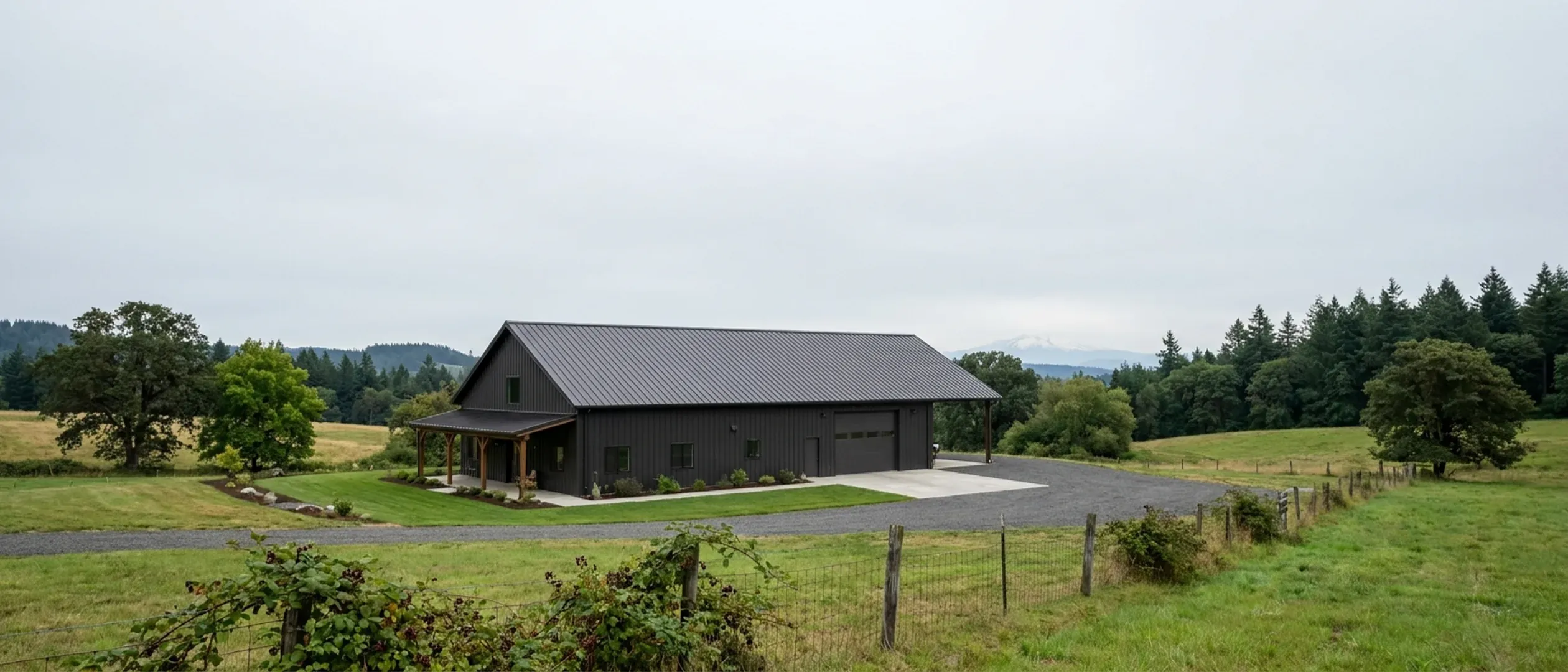
Barndominium Financing in Oregon
There is no special barndominium loan. A barndominium that is someone's home is financed the way any newly built house is: usually with a construction loan that becomes a mortgage when the house is finished. What makes it harder is the appraisal. A lender lends against what the finished home will be worth, and in rural Oregon there may be few sales of anything like it nearby. This guide explains how construction-to-permanent loans work under Fannie Mae's rules, what the appraisal rules say about unusual and rural homes, what USDA's rural housing programs allow, and which Oregon lenders publish loans for rural homes, shop-homes and barndominiums. The lenders named are examples with their own published terms, not recommendations, and we do not arrange loans.
Figures on this page are cited third-party or government data, not a quote from Oregon Barndominium Builders.
Bottom Line Up Front
- Most barndominiums are financed with a construction-to-permanent loan. Under Fannie Mae's single-closing rules the construction period may not exceed 18 months in total, and the loan then converts automatically to a mortgage of up to 30 years.
- The appraisal is the usual hurdle. Fannie Mae's Selling Guide accepts unique homes when the appraiser has enough information to reach a reliable value, and it allows distant or older comparable sales for rural properties if the appraiser explains them.
- Cash is common in this market: the Census Bureau reports that 32% of contractor-built houses started in the West region in 2025 were paid for in cash, against 65% with conventional loans.
What actually moves the number
The interest rate when you lock
Freddie Mac's Primary Mortgage Market Survey reported a 30-year fixed rate of 7.03% for the week of 24 September 2026, against 6.30% a year earlier, and a 15-year rate of 6.42%. A construction loan is priced separately, often interest-only during the build, and many lenders let you lock the permanent rate at closing.
Whether you own the land
Under Fannie Mae's single-closing rules, a borrower who already owns the lot is treated as a limited cash-out refinance, with the loan-to-value measured against the as-completed appraised value of lot and house. A borrower buying the lot with the loan is treated as a purchase, measured against the lesser of the total cost or the as-completed value. Land you own outright counts toward your equity.
The as-completed appraisal
The lender lends against what the finished home will appraise for, not what it costs. If the few comparable sales nearby are older or less finished, the appraisal can come in below cost and the gap is yours to cover in cash.
How big the shop is
Fannie Mae asks lenders to give properties with outbuildings special consideration and to decide whether a property is residential in nature. Significant outbuildings such as large barns and storage areas may indicate an agricultural property. A barndominium where the shop dwarfs the living space can raise that question, and a lender may value the shop at little or nothing.
Barndominium loans: what actually exists
A home loan, not a barndominium loan
Lenders finance the use, not the look. A barndominium built as a primary residence is financed as a newly built home. Some lenders, such as AgWest Farm Credit, say on their loan pages that they finance barndominiums and shop-homes, which usually means they are used to appraising them.
How new homes in the West are paid for
For contractor-built houses started in the West region in 2025, the Census Bureau reports 65% financed with conventional loans, 1% FHA, 2% VA and 32% cash. The cash share is high because many owner-land builds are paid from savings, land sales or a previous home.
The land loan comes first for many buyers
If you do not own the land yet, it is often bought first with cash or a land loan, and then used as equity in the construction loan. Rogue Credit Union, for example, publishes land loans of up to 85% of the land's value.
A kit on its own is harder to finance
A lender lends against a finished home it can appraise. A kit bought on its own, before there is a construction contract and plans for a finished dwelling, is usually paid for in cash or folded into the construction loan's budget.
Construction-to-permanent loans
These are the rules Fannie Mae publishes for single-closing construction-to-permanent loans it buys (Selling Guide B5-3.1-02, dated 05/06/2026). Individual lenders can be stricter.
One closing, automatic conversion
Because the loan documents set the terms of the permanent financing, the construction loan converts automatically to a permanent mortgage when construction is complete. There is one closing instead of two.
The construction period
No single construction period may be longer than 12 months, and the total, with any extension, may not exceed 18 months. After conversion, the loan term may not exceed 30 years, not counting the construction period.
How the loan-to-value is measured
If you already own the lot, the loan is divided by the as-completed appraised value of lot and home. If the loan buys the lot, it is divided by the lesser of the total cost (construction plus lot) or the as-completed value.
Documents go stale
Credit, income and employment documents must be no more than four months old at the construction loan closing, and generally again at conversion, with a limited exception. A long build can mean re-documenting before the permanent loan starts.
The appraisal problem, and what the rules allow
Rural homes often lack comparable sales
Fannie Mae's Selling Guide notes that rural properties often have large lots and relatively undeveloped surroundings, so there may be a shortage of recent truly comparable sales nearby. If the best comparables are a considerable distance away, the appraiser may use them with an explanation.
Older sales can be used
Where a rural area has minimal sales activity, the Selling Guide lets the appraiser use comparable sales older than 12 months if they explain why.
Unique homes are eligible
The Selling Guide treats unique or nontraditional housing as eligible when the appraiser has enough information to reach a reliable value, and says it is not necessary for any comparable to be of the same design and appeal. The appraiser and the underwriter each decide, case by case, whether that information exists.
What helps the appraisal
A complete set of plans and a detailed cost breakdown, a finish level in line with the houses around it, and a lender whose appraisers know rural property all help. AgWest Farm Credit, for example, says its rural home loan specialists are familiar with appraisals and collateral that may not be typical.
USDA Rural Development: what the rules allow
USDA's single-family housing programs are set out in the Code of Federal Regulations. Whether an address is in an eligible rural area, and whether a household's income qualifies, is checked on USDA's eligibility site.
Direct loans can build a home
Under 7 CFR 3550.52, Section 502 direct loan funds may be used to buy, build, rehabilitate, improve or relocate an eligible dwelling for use as a permanent residence. Household income must be within the program's low-income limit at approval.
The home must be modest
Under 7 CFR 3550.57, a direct-loan property must be modest for the area and must not be designed for income-producing purposes. During construction, an adult member of the household must be available to make inspections and authorize progress payments.
Guaranteed loans can fund new construction
Under 7 CFR 3555.101, guaranteed loan funds may be used for the construction or purchase of a new dwelling, including site preparation such as grading, foundation and driveways.
Site rules that matter for a barndominium
Under 7 CFR 3555.201, the site size must be typical for the area; property used primarily for agriculture, farming or commercial enterprise is ineligible; the site must have access from a hard-surfaced or all-weather road; and it must have adequate utilities, water and wastewater systems. A large acreage or a working shop can fail those tests.
How to finance a barndominium in Oregon, step by step
Settle the land question first
Confirm with the county that a dwelling is allowed on the parcel, and get the septic site evaluation. A lender will not finance a home the county has not approved, and the septic answer changes the budget.
Talk to a lender who finances rural homes
Ask directly whether they have closed loans on barndominiums or shop-homes, how they treat a large shop, and whether they offer a single-closing construction-to-permanent loan.
Bring plans and a full budget
The appraiser values the finished home from the plans and specifications. A budget that covers the site, septic, well and interior as well as the shell makes the as-completed value believable.
Plan for an appraisal gap
Keep a reserve for the case where the as-completed appraisal comes in below cost. Land you already own counts toward your equity.
Reading this because you are weighing a build? The next step is a plan drawn for your program.
What's different about Oregon
Farm Credit serves rural Oregon through AgWest
The Farm Credit network lists AgWest Farm Credit and CoBank as its institutions in Oregon. AgWest publishes a Country Home Loan program for rural homes and says it finances manufactured, modular, log homes, shop-homes and barndominiums, as well as acreages without water, power or septic. It also publishes an all-in-one construction loan with one closing and interest-only payments during construction.
Oregon credit unions publish construction loans
As one example, Rogue Credit Union publishes a construction loan that combines short-term construction and permanent financing, with interest-only payments during a 12-month construction period and 10- to 30-year terms, and land loans of up to 85% of the land's value. Terms change and are subject to credit approval; read the lender's current page.
Oregon Housing and Community Services runs Flex Lending
Oregon Housing and Community Services operates the Flex Lending program through approved lenders, with two loan products: FirstHome, designed for first-time homebuyers, and NextStep. Either may be paired with down payment assistance. Ask an approved lender whether the product fits a construction loan.
Farm-zoned land raises lender questions
USDA's guaranteed loan rules make property used primarily for agriculture, farming or commercial enterprise ineligible, and Fannie Mae asks whether a property is residential in nature. On a parcel in an exclusive farm use zone, expect the lender to ask how the land is used and whether the dwelling has its county land-use approval.
Pros and cons, honestly
Pros
- A single-closing construction-to-permanent loan means one closing and an automatic conversion to a mortgage.
- Land you already own counts toward your equity in the loan.
- Farm Credit's Oregon lender, AgWest, publishes that it finances shop-homes and barndominiums.
- USDA's programs can fund new construction in eligible rural areas for households that qualify.
Cons
- Few comparable sales can make a barndominium appraise below its cost.
- A shop much larger than the home can lead a lender to question whether the property is residential.
- Construction periods are capped, so a slow build can put the conversion at risk.
- USDA's site rules exclude property used primarily for agriculture and require a site size typical for the area.
Can you get a mortgage for a barndominium in Oregon?
What is a construction-to-permanent loan?
Why do barndominiums have trouble appraising?
Can I use a USDA loan for a barndominium?
Can I finance the land and the build together?
What are current mortgage rates for a new build?
Can I finance a barndominium kit on its own?
Questions answered? Tell us what you want to build and we will put real numbers against it.
Sources
- Fannie Mae Selling Guide — B5-3.1-02, Conversion of Construction-to-Permanent Financing: Single-Closing Transactions (05/06/2026) — Automatic conversion; 12/18-month construction period; LTV by lot ownership. Read 26 Sep 2026.
- Fannie Mae Selling Guide — B4-1.3-08, Comparable Sales (06/04/2025) — Rural properties; older comparable sales. Read 26 Sep 2026.
- Fannie Mae Selling Guide — B4-1.3-05, Improvements Section of the Appraisal Report (06/04/2025) — Unique housing types; properties with outbuildings. Read 26 Sep 2026.
- U.S. Census Bureau — Number of Contractor-Built Houses Started by Type of Financing (Characteristics of New Housing, 2025) — Sheet ContrStartsbyFinancing. West 2025: conventional 65%, FHA 1%, VA 2%, cash 32%. Read 26 Sep 2026.
- Freddie Mac — Primary Mortgage Market Survey, historical data — 30-year 7.03% and 15-year 6.42% (week of 24 Sep 2026); 30-year 6.30% (week of 25 Sep 2025).
- eCFR — 7 CFR 3550.52, Loan purposes (Section 502 direct) — Read via the eCFR API, current as of 24 Sep 2026.
- eCFR — 7 CFR 3550.53, Eligibility requirements (Section 502 direct) — Read via the eCFR API, current as of 24 Sep 2026.
- eCFR — 7 CFR 3550.57, Dwelling requirements (Section 502 direct) — Read via the eCFR API, current as of 24 Sep 2026.
- eCFR — 7 CFR 3555.101, Loan purposes (guaranteed loans) — Read via the eCFR API, current as of 24 Sep 2026.
- eCFR — 7 CFR 3555.201, Site requirements (guaranteed loans) — Read via the eCFR API, current as of 24 Sep 2026.
- USDA Income and Property Eligibility Site — Address and income eligibility checks. Read 26 Sep 2026.
- Farm Credit — Oregon (Farm Credit institutions in Oregon) — Lists AgWest Farm Credit and CoBank. Read 26 Sep 2026.
- AgWest Farm Credit — Country Home Loans: Home Loans — Rendered page read 26 Sep 2026.
- AgWest Farm Credit — Country Home Loans: Construction Loans — Rendered page read 26 Sep 2026.
- Rogue Credit Union — Home Loans (land and construction loans) — Construction and land loan terms as published 26 Sep 2026; subject to credit approval.
- Oregon Housing and Community Services — Flex Lending (Lenders and Real Estate Professionals) — FirstHome and NextStep through approved lenders. Read 26 Sep 2026.
Keep reading
The pages that answer the next question this one raises.
How Much Does It Cost to Build a Barndominium in Oregon?
The published cost per square foot a lender's budget review will be compared with.
Read itWhat Size Can Your Budget Build?
Turn a loan amount into square feet after land, septic and fees.
Read itBarndominium vs House Cost
Why a barndominium can appraise differently from a house of the same size.
Read itCustom Barndominium Plans
Complete plans are what an appraiser values an unbuilt home from.
Read itWant a real number instead of a range?
Start the survey and tell us about your land and what you want to build. Include the county and tax lot number if you have them, because in Oregon the zoning, the septic site evaluation and the well answer change the budget more than the building does. The survey costs nothing.