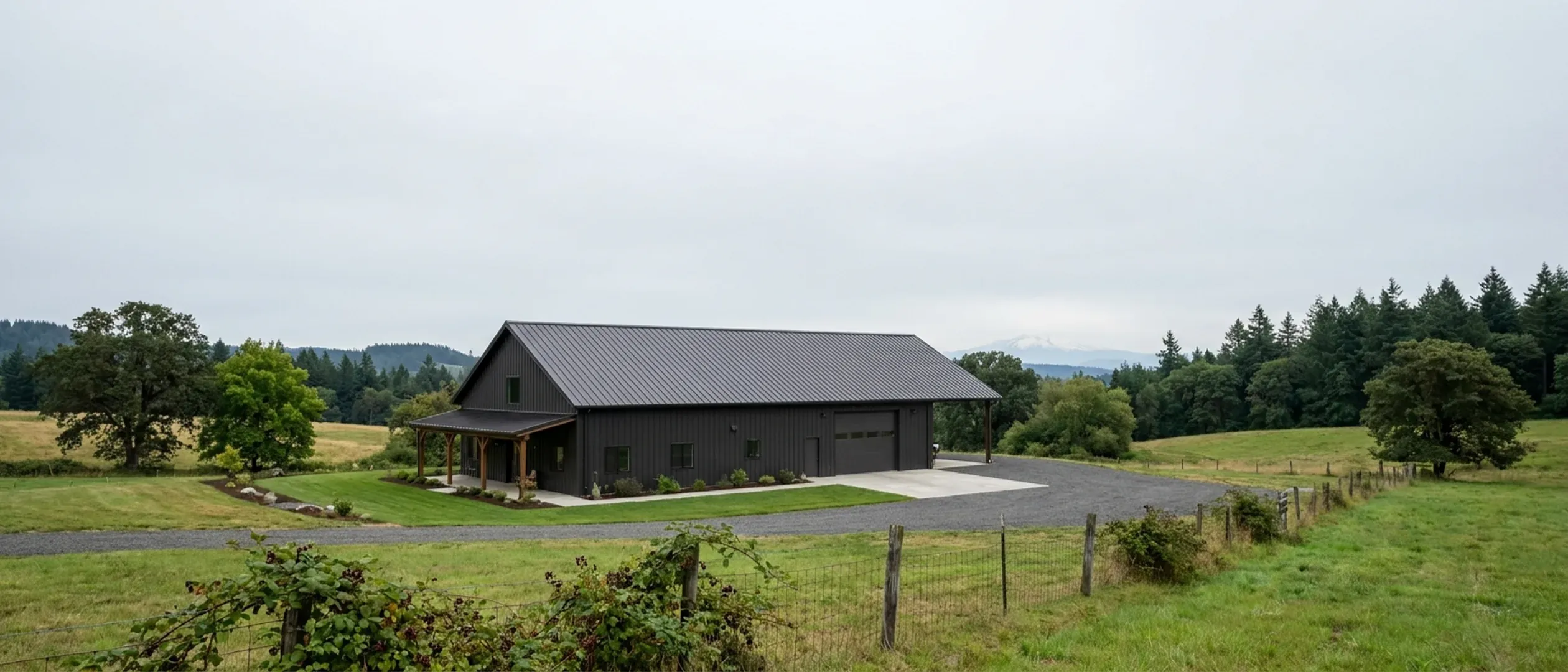
What Size Barndominium Can You Build for Your Budget in Oregon?
The question people ask is how big a barndominium they can build for a given amount. The honest method has three steps, and the order matters. First take off the costs that come with the land: the parcel itself, the septic system, the well, the driveway and, inside a city, the system development charges. Then divide what is left by a published cost per square foot for finished houses; the Census Bureau reports one for contractor-built houses in the West region, which includes Oregon. Last, stretch the footprint by leaving part of it as shop. The figures below are that arithmetic on the Census numbers, not our pricing and not a quote.
Figures below are industry data from cited third-party sources, not a quote from Oregon Barndominium Builders. Every project is priced individually.
Bottom Line Up Front
- At the Census Bureau's 2025 West figures for contractor-built houses ($176.87 median and $213.85 average per square foot, land excluded), $300,000 of building budget covers roughly 1,403 to 1,696 finished square feet.
- Land and site costs come off the top first. USDA puts 2026 Oregon pasture at $1,120 an acre, and the 2022 study for Oregon Housing and Community Services put the statewide average of city system development charges for a single-family home at roughly $15,000.
- Shop space finished as a shop costs far less per foot than living space, so a barndominium budget usually stretches further in total footprint than in finished area.
Published cost figures
Third-party and government figures, each with its source. None of them is a quote, and none of them is ours.
| Measure | Range | Source |
|---|---|---|
| Contractor-built houses on the owner's land, West region, started in 2025: median to average contract price (land excluded) | $177–$214 per sq ft | U.S. Census Bureau, Characteristics of New Housing 2025, Median and Average Contract Price per Square Foot of New Contractor-Built Single-Family Houses Started: West median $176.87, average $213.85 (read 26 Sep 2026) — https://www.census.gov/construction/chars/xls/contractpricesqft_cust.xls |
Total cost by size
Rough totals at common sizes. These move with everything on this page, so treat them as a starting orientation, not an estimate for your project.
1,000 sq ft
$177,000–$214,000
Arithmetic, rounded to the nearest $1,000: 1,000 sq ft × the Census 2025 West contract price per sq ft ($176.87 median, $213.85 average), land excluded — https://www.census.gov/construction/chars/xls/contractpricesqft_cust.xls
1,500 sq ft
$265,000–$321,000
Arithmetic, rounded to the nearest $1,000: 1,500 sq ft × the Census 2025 West contract price per sq ft ($176.87 median, $213.85 average), land excluded — https://www.census.gov/construction/chars/xls/contractpricesqft_cust.xls
2,000 sq ft
$354,000–$428,000
Arithmetic, rounded to the nearest $1,000: 2,000 sq ft × the Census 2025 West contract price per sq ft ($176.87 median, $213.85 average), land excluded — https://www.census.gov/construction/chars/xls/contractpricesqft_cust.xls
2,500 sq ft
$442,000–$535,000
Arithmetic, rounded to the nearest $1,000: 2,500 sq ft × the Census 2025 West contract price per sq ft ($176.87 median, $213.85 average), land excluded — https://www.census.gov/construction/chars/xls/contractpricesqft_cust.xls
What actually moves the number
Land first
USDA's 2026 averages for Oregon are $1,120 an acre for pasture, $3,050 for non-irrigated cropland and $8,200 for irrigated cropland. A small acreage with an approved homesite is priced by its own market, and on farm-assessed land in an exclusive farm use zone the additional tax on leaving farm assessment is part of the land cost, because ORS 215.236 requires it to be paid before a non-farm dwelling is finally approved.
Septic, well and power
Off the city sewer, the septic site evaluation is charged per lot by DEQ or the county acting as its contract agent, and the system type it allows sets the larger cost. A household well for domestic use up to 15,000 gallons a day needs no state groundwater permit under ORS 537.545, but the drilling and pump are still a line. Budget both before dividing anything by square feet.
City fees
Inside a city, system development charges are collected at the building permit or at connection. The 2022 study for Oregon Housing and Community Services found totals for a single-family home from under $5,000 in some small cities to close to $50,000 in some Portland metro jurisdictions. A growing number of cities scale the charge to the size of the home, so ask the city how its schedule treats the plan you are pricing.
The finish level
NAHB's 2024 survey puts interior finishes at 24.1% of construction cost and the plumbing, electrical and HVAC rough-ins at 19.2%. Those two lines move the cost per square foot more than the choice of shell, so a modest finish schedule buys more floor area than a cheaper frame does.
Step 1: take the land and site costs off the top
Land
If the land is not yet paid for, it comes out of the budget first. USDA's 2026 Oregon averages ($1,120 an acre for pasture, $3,050 for non-irrigated cropland) describe farm land in general, not an acreage with an approved homesite.
Site work and driveway
NAHB's 2024 survey puts excavation, foundation and concrete at 10.0% of construction cost and the driveway at 2.3%, on a typical lot. A long rural approach or a hillside pad adds to both.
Septic and well
Get the septic site evaluation before settling the budget. The system type it allows, and the depth of the well, are site answers that no statewide figure can supply.
Fees
Building permit and plan review fees are set by the jurisdiction. Inside a city, add its system development charges; the 2022 statewide average for a single-family home was roughly $15,000, according to the study for Oregon Housing and Community Services.
Step 2: divide what is left by a published cost per square foot
These rows divide a building budget by the Census 2025 West figures for contractor-built houses: $213.85 average and $176.87 median per square foot, land excluded. The smaller figure uses the average.
A $100,000 building budget
About 468 to 565 finished square feet at the Census figures. At this budget a shell finished over time is often the realistic plan.
A $200,000 building budget
About 935 to 1,131 finished square feet at the Census figures, roughly a compact two-bedroom plan.
A $300,000 building budget
About 1,403 to 1,696 finished square feet at the Census figures.
A $400,000 building budget
About 1,870 to 2,262 finished square feet at the Census figures. For comparison, the Census reports that the median contractor-built house completed in the West in 2025 had 2,354 square feet.
A $500,000 building budget
About 2,338 to 2,827 finished square feet at the Census figures.
Step 3: stretch the footprint with unfinished space
Price living space and shop space separately
A shop with a concrete floor and little interior finish skips much of the 24.1% that NAHB attributes to interior finishes. Price the living area at a finished-house rate and the shop at a shop rate, and the total footprint grows.
Finish in phases
Some owners close in the whole shell and finish part of it later. Check with your lender first: a construction-to-permanent loan usually expects a finished, habitable home at conversion.
Keep the plan simple
A rectangle under one roof keeps framing and roofing simple. Every jog, dormer and valley adds labour and material without adding floor area.
Watch the mechanical systems
Plumbing, electrical and HVAC are each about 6% of construction cost in NAHB's survey. Keeping bathrooms and the kitchen close together shortens the runs.
Reading this because you are weighing a build? The next step is a plan drawn for your program.
What's different about Oregon
The land-use answer sets the budget's floor
Outside an urban growth boundary, county zoning, whether farm, forest or rural residential, decides whether a house is allowed, and on exclusive farm use and forest land a dwelling has to qualify under state tests in ORS chapter 215 and be approved by the county. A parcel where a dwelling cannot be approved has no building budget at all, so the county planning answer comes before the square-foot arithmetic.
Farm tax deferral can come due
Under ORS 308A.703, the additional tax when farm land leaves special assessment is the difference between the taxes charged and the taxes that would otherwise have been charged, for up to ten years where the land stays outside an urban growth boundary. On a farm-assessed parcel, ask the county assessor for that figure before counting what is left for the building.
No sales tax on materials
The Oregon Department of Revenue states that Oregon does not have a general sales or use tax, so a kit or materials budget carries no sales tax on top. Some building permits do carry a local construction excise tax, collected with the permit.
Where city fees scale with size
The 2022 study for Oregon Housing and Community Services found a growing number of jurisdictions adjusting system development charges to the size of the housing unit. Where a city does that, a smaller home also costs less in fees, which is one more reason to price the plan against the city's actual schedule.
Pros and cons, honestly
Pros
- The method works for any budget, because it starts from your land and fees rather than from a national average.
- Shop space finished as a shop stretches the total footprint well beyond the finished living area.
- Oregon has no general sales tax on materials, though some permits carry a construction excise tax.
- Where a city scales system development charges to home size, a smaller plan also pays smaller fees.
Cons
- The Census figures describe the West region, not Oregon alone, and conventional houses, not barndominiums.
- Land, septic and well costs are site answers and can take a large share of a small budget.
- On farm-assessed land in an exclusive farm use zone, the additional tax on leaving farm assessment can come due before a non-farm dwelling is approved.
- Finishing in phases can conflict with a construction loan that expects a finished home at conversion.
How big a barndominium can I build for $200,000 in Oregon?
How big a barndominium can I build for $100,000?
What does a 2,000 square foot barndominium cost in Oregon?
Does a shop count in the square footage?
What should I pay for before the building?
Are city fees lower for a smaller barndominium?
Can I finish the barndominium in stages to fit the budget?
Questions answered? Tell us what you want to build and we will put real numbers against it.
Sources
- U.S. Census Bureau — Median and Average Contract Price per Square Foot of New Contractor-Built Single-Family Houses Started (Characteristics of New Housing, 2025) — West 2025: median $176.87, average $213.85, lot excluded. Read 26 Sep 2026.
- U.S. Census Bureau — Median and Average Square Feet of Floor Area in New Single-Family Houses Completed: Contractor-Built (Characteristics of New Housing, 2025) — West 2025: median 2,354, average 2,751 sq ft. Read 26 Sep 2026.
- NAHB — Cost of Constructing a Home 2024 (January 2025) — Construction cost shares by stage; national averages. Read 26 Sep 2026.
- USDA National Agricultural Statistics Service — Land Values 2026 Summary — Oregon 2026: pasture $1,120, non-irrigated cropland $3,050, irrigated $8,200 per acre.
- Oregon System Development Charges Study, Final Report (for Oregon Housing and Community Services, December 2022) — Single-family totals and size-scaled charges. Read 26 Sep 2026.
- Oregon Revised Statutes chapter 215 — exclusive farm use zones (ORS 215.236) — Read 26 Sep 2026.
- Oregon Revised Statutes chapter 308A — additional taxes upon disqualification (ORS 308A.703) — Read 26 Sep 2026.
- Oregon Revised Statutes chapter 537 — exempt groundwater uses (ORS 537.545) — Read 26 Sep 2026.
- Oregon Department of Revenue — Sales Tax in Oregon — Read 26 Sep 2026.
- Oregon Revised Statutes chapter 320 — construction taxes (ORS 320.170, 320.192) — School district, city and county construction excise taxes collected with the permit. Per the statewide research file, read 26 Sep 2026.
Keep reading
The pages that answer the next question this one raises.
How Much Does It Cost to Build a Barndominium in Oregon?
The published cost per square foot, land values and city fees behind this arithmetic.
Read itBarndominium Financing in Oregon
How a construction-to-permanent loan sizes what you can borrow.
Read it30x40 Barndominium Plans
A compact footprint for a smaller budget.
Read itSmall Barndominium Plans
Plans sized for the lower end of the budget table.
Read itWant a real number instead of a range?
Start the survey and tell us about your land and what you want to build. Include the county and tax lot number if you have them, because in Oregon the zoning, the septic site evaluation and the well answer change the budget more than the building does. The survey costs nothing.