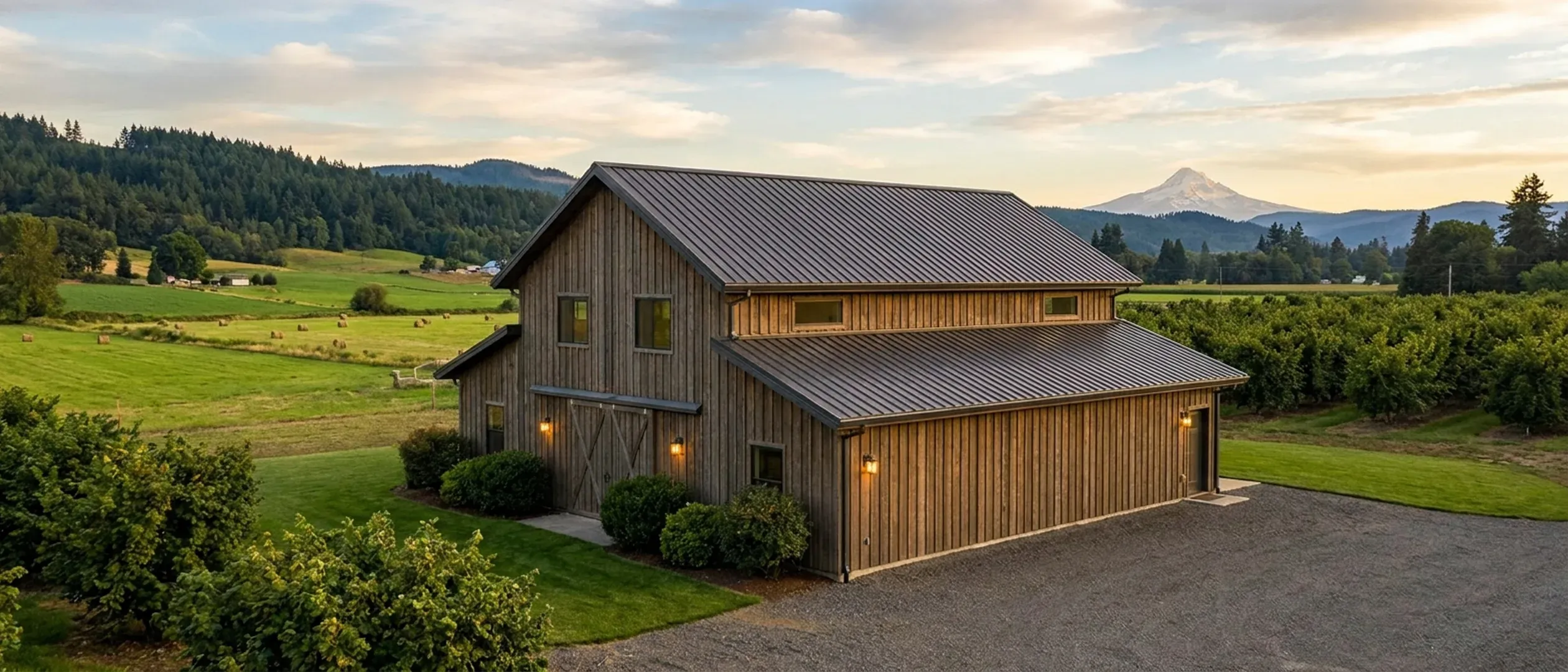
Are Barndominiums Worth It in Oregon? Land Use, Appraisal, Insurance and Climate
Whether a barndominium is worth it depends on what you need the building to do, where the land is, and how long you plan to stay. In Oregon one question sits in front of all of those: whether the land allows a dwelling at all. Statewide land-use planning, urban growth boundaries and farm and forest zoning mean the right parcel is scarcer, and more valuable, than the building type. After that the familiar questions return, with an Oregon shape: how an appraiser values a barndominium on rural acreage, how an insurer weighs wildfire exposure, and what it takes to keep a metal building dry on the wet west side and warm through a Central Oregon winter. This page sets out when a barndominium usually is worth it, when it usually is not, and what to check before deciding. It publishes no prices of its own. For costs, see the cost guide, which cites its sources.
Figures on this page are cited third-party or government data, not a quote from Oregon Barndominium Builders.
Bottom Line Up Front
- A barndominium is usually worth it when you need a shop or equipment space anyway, have or can buy land that allows a dwelling, and plan to stay long enough that resale matters less than how the building works for you.
- In Oregon the land is the first test, not the building. Confirm with the planning department that a dwelling is allowed on the parcel before anything else is spent.
- The Oregon-specific cautions are rural appraisals with few comparable sales, wildfire risk that insurers price with their own models, and a climate that makes insulation and moisture control part of the value, not an extra.
When a barndominium is usually worth it
These are the situations where the building type's strengths line up with what the owner actually needs.
You need the shop anyway
If you would otherwise build a house and a separate shop, equipment building or large garage, one structure on one foundation can do both. That is where a barndominium's economics are strongest.
The land already allows a dwelling
A parcel zoned for a house, with a known septic answer and water supply, removes the biggest Oregon uncertainty. On that kind of land the building type becomes a straightforward choice.
You want an open plan that can change
A clear-span shell has no interior bearing walls, so rooms can be rearranged later without structural work.
You are staying a long time
The value of a building that suits you exactly is realised over years of living in it. The longer the horizon, the less a thin resale market matters.
When it usually is not
In these situations a conventional house, or a different parcel, is often the better choice.
The zoning does not clearly allow a dwelling
Buying farm or forest land on the assumption that a house can be added later is the most expensive mistake an Oregon barndominium buyer can make. If the planning department cannot confirm it, the land is not yet a building site.
You may sell within a few years
A barndominium on rural acreage can take longer to sell and to appraise than a conventional house in town.
The loan depends on a high appraisal
Where few comparable sales exist, the appraised value may come in below what the building cost. A plan that only works at a high appraisal is fragile.
The shop is bigger than the house needs
An oversized shop may add little appraised value, and a very large one can make a lender ask whether the property is residential or agricultural.
What to check before deciding
Each of these can be done before money is committed to a kit or a design.
The zoning, in writing
Ask the county or city planning department what the zone allows, whether a dwelling needs a land-use decision, and what that process involves.
The septic and water answer
Whether the soil will take an onsite system and where the water will come from decide whether the parcel works at all.
An insurance quote on the actual design
Ask how the insurer treats the site's wildfire exposure and which hardening and defensible-space measures it credits.
A lender that has financed one
Ask how its appraisers have valued barndominiums on rural land and how it treats a large shop. The financing guide covers the loan types.
The site's snow, wind and seismic figures
The Building Codes Division's Oregon Design Criteria Hub gives them for each site, and your building department confirms them. They decide what the frame must be engineered for, and therefore what the kit costs.
Reading this because you are weighing a build? The next step is a plan drawn for your program.
What's different about Oregon
The land decides first
In Oregon a barndominium is a house, and where a new house may go is governed by statewide land-use planning: ORS 197.175 requires every city and county to plan and zone to statewide goals. ORS 215.203 reserves land in exclusive farm use zones for farm use except where the statutes allow a dwelling under specific tests, and forest zones have tests of their own. On farm-deferred land a nonfarm dwelling also ends the deferral, and ORS 308A.703 can bring up to ten years of additional tax. A parcel that already allows a dwelling is worth more to a barndominium buyer than a cheaper one that may not. The legal guide sets out how the rules work and what to ask before you buy.
No sales tax on the kit, but check for a construction excise tax
The Oregon Department of Revenue says Oregon does not have a general sales or use tax, so kit materials bought in Oregon carry no sales tax. Some building permits do carry a construction excise tax, which ORS 320.170 allows school districts to impose and the permit office collects. Freight, site work and the trades are where most of the money goes.
Wildfire is priced by the insurer
The Oregon Division of Financial Regulation says the state wildfire hazard map was repealed in 2025 by SB 83, but that the repeal does not change insurers' practice of using their own risk models, and that wildfire risk remains a very important consideration. Under SB 82, insurers must consider home hardening and defensible space in rating and underwriting. A metal roof and metal walls help, and so do the details around them. Get an insurance quote on the actual design and site before committing.
Appraisal on acreage
Fannie Mae's Selling Guide notes that rural properties may lack recent truly comparable sales nearby and allows appraisers to use more distant or older sales with an explanation. It treats unique housing as eligible where the appraiser has enough information for a reliable value, and it says an atypical outbuilding may be given little or no contributory value. A barndominium's value to a lender rests on how well the appraiser can support it, which is easier in areas where others have already sold.
Climate sets the running costs
The Oregon Climate Change Research Institute describes winters west of the Cascades as mild and wet, and Central Oregon as dry, with large swings between day and night. The EPA's moisture-control guidance explains that condensation forms wherever warm, humid air meets a surface colder than its dew point, which is exactly what a steel panel is on a winter night. Insulation, air sealing and vapour control are what make a barndominium comfortable and durable in either climate, and they are where cutting corners costs the most later.
Rural land carries its own projects
Most barndominiums are built where there is no sewer or public water. A septic system needs a Department of Environmental Quality permit under ORS 454.655, issued by DEQ or the county acting for it, after a site evaluation that DEQ says does not guarantee any particular system. A household well usually needs no water right, since ORS 537.545 exempts domestic use up to 15,000 gallons a day, but it must be built by a licensed well constructor. The driveway, power and the dig notice that ORS 757.557 requires before excavation are part of the budget too. None of that is about the building type, but it is part of whether the whole project is worth it.
Pros and cons, honestly
Pros
- One building and one foundation can replace a house and a separate shop.
- A clear-span shell leaves the floor plan free to change later.
- Oregon has no general sales tax on materials, according to the Department of Revenue.
- Metal roofing and siding are noncombustible surfaces where wildfire is the risk.
- A kit shell goes up quickly, which helps fit the build inside a dry season.
Cons
- Land-use rules decide whether a dwelling is allowed, and suitable land can be scarce.
- Rural appraisals can be difficult where there are few comparable sales.
- Insurers price wildfire risk with their own models.
- A large shop may add less value than it cost.
- Insulation and moisture control have to be done properly on either side of the Cascades.
Are barndominiums worth it in Oregon?
Do barndominiums hold their value in Oregon?
Is it cheaper to build a barndominium than a house in Oregon?
Does Oregon charge sales tax on a barndominium kit?
Can I build a barndominium on farmland in Oregon?
Will wildfire risk make a barndominium hard to insure?
Can I get a mortgage on a barndominium?
What should I do before deciding?
Questions answered? Tell us what you want to build and we will put real numbers against it.
Sources
- Oregon Department of Revenue — Sales Tax in Oregon
- Oregon Revised Statutes, Chapter 320 — ORS 320.170 (construction taxes)
- Oregon Revised Statutes, Chapter 197 — ORS 197.175 (comprehensive land use planning)
- Oregon Revised Statutes, Chapter 215 — ORS 215.203 (exclusive farm use zones)
- Oregon Revised Statutes, Chapter 308A — ORS 308A.703 (additional tax on disqualification)
- Oregon Revised Statutes, Chapter 454 — ORS 454.655 (septic permits)
- Oregon Department of Environmental Quality — Residential septic systems
- Oregon Revised Statutes, Chapter 537 — ORS 537.545 (exempt groundwater uses)
- Oregon Building Codes Division — Oregon Design Criteria Hub
- Oregon Division of Financial Regulation — Wildfire insurance
- Fannie Mae Selling Guide — B4-1.3-08, Comparable Sales
- Fannie Mae Selling Guide — B4-1.3-05, Improvements Section of the Appraisal Report
- Oregon Climate Change Research Institute (Oregon State University) — Climate of Oregon
- U.S. EPA — Moisture Control Guidance for Building Design, Construction and Maintenance
- Oregon Revised Statutes, Chapter 757 — ORS 757.557 (notice before excavation)
Keep reading
The pages that answer the next question this one raises.
Barndominium pros and cons in Oregon
Rain, condensation, snow, wildfire and appraisal in detail.
Read itAre barndominiums legal in Oregon?
Zoning, farm and forest land, septic, wells and permits.
Read itBarndominium cost in Oregon
Third-party cost figures and what drives them.
Read itBarndominium vs house cost
Where the savings are real and where they are not.
Read itBarndominium financing
Loan types and how appraisal affects them.
Read itStart the survey
Tell us about your land and what you want to build.
Read itWant a real number instead of a range?
Start the survey and tell us about your land and what you want to build. Include the county and tax lot number if you have them, because in Oregon the zoning, the septic site evaluation and the well answer change the budget more than the building does. The survey costs nothing.